Key events
London stock market opens higher on shutdown deal hopes
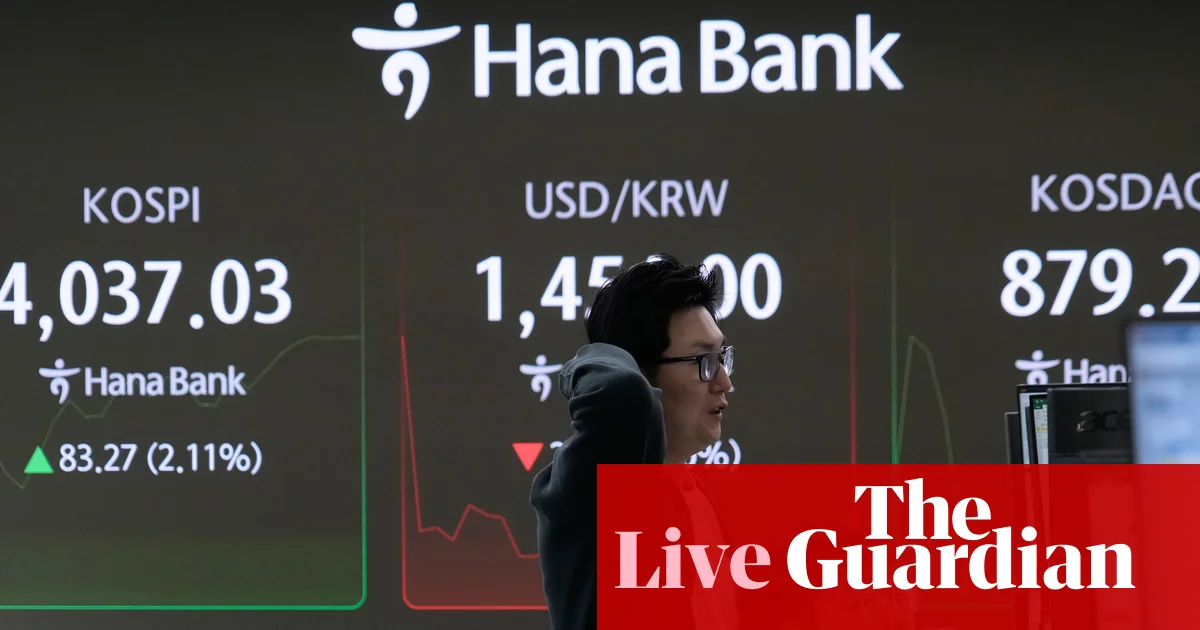
Britain’s stock market have jumped at the start of trading, on relief that a bipartisan deal that could end the US government shutdown has been reached.
The FTSE 100 index of blue-chip shares is up 68 points, or 0.7%, at 9752 points – just 35 points away from the record high.
Mining stocks, and luxury goods maker Burberry, are among the top risers.
Ipek Ozkardeskaya, senior analyst at Swissquote, says the market looks calmer this morning.
The news that the US government shutdown could finally come to an end lifts market sentiment, after the Senate put together the 60 votes needed to push the deal through its first stage.
It’s only the opening act in what could still be a drawn-out political drama, but investors are seizing on any sign of progress to end the longest US government shutdown in history and feed on data — data they need to understand where the US economy stands, where inflation and jobs are headed, and what the Federal Reserve (Fed) should do next.
Diageo names former Tesco boss Dave Lewis as chief
UK drinks giant Diageo has turned to experienced retailer Sir Dave Lewis to lead its turnaround push.
Lewis, the former chief executive of Tesco, has been named this morning as Diageo’s new chief executive.
He succeeds Debra Crew, who stepped down “by mutual agreement” in July after a tenure including a shock profits warning, adverse global consumer trends and abandoned sales targets.
Just last week, Diageo reported that weak demand in China and the US had hurt sales and profit expectations.
Lewis, who must now restore investor confidence in Diageo, says:
“Diageo is a world leading business with a portfolio of very strong brands, and I am delighted to be joining the team. The market faces some headwinds but there are also significant opportunities. I look forward to working with the team to face these challenges and realise some of the opportunities in a way which creates shareholder value.”
Lewis has experience of turning businesses around – at Tesco, he tackled a mountain of debt and discovered a gaping black hole in its accounts.
Lewis will step down down from his current role chairing consumer healthcare firm Haleon at the end of the year.
Shutdown end could bring flurry of delayed data
Once the government reopens, markets will face a surge of delayed data releases.
Jim Reid, market strategist at Deutsche Bank, has told clients this morning:
It looks like white smoke is finally emerging from Capitol Hill as late on Sunday night in the Senate there was a 60-40 procedural vote to advance a bill that would end the shutdown. Just about enough moderate Democrats have broken ranks with party leadership to progress a bill that would fund Agriculture, Veterans Affairs and the operations of Congress for the full-year, even if other agencies would only be funded through to January 30th. It seems to persuade the moderate Democrats to support the bill, a vote has been promised in December in extending the Affordable Care Act (ACA) subsidies that run out at year-end. The timetable from here is slightly less clear but we could get a full vote today or tomorrow assuming no procedural delays.
Probability markets are starting to price in the end game with a 98% expectation that the shutdown will be over by November 30th on Polymarket, a contract high.
Historical precedent from the 2013 shutdown suggests that September’s employment report could be among the first to hit the wires, potentially within three business days of reopening. We expect payrolls to rebound sharply, with headline and private payrolls both forecast at +75k, leaving the unemployment rate steady at 4.3%. So we could get this Thursday or Friday.
Introduction: Markets welcome deal to end US shutdown
Good morning, and welcome to our rolling coverage of business, the financial markets and the world economy.
After some jittery sessions last week, the markets are taking heart from progress to end the longest US government shutdown in history.
Wall Street futures are indicating a higher open, after the US Senate voted to advance legislation to end the shutdown, with a group of breakaway Democrats reached an agreement with Republicans.
This compromise bill would reauthorize funding and undo the layoffs of some employees, but doesn’t guarantee the extension of healthcare tax credits, which had been a key Democrat demand.
If the Senate eventually passes the bill, the package must still be approved by the House of Representatives and sent to President Donald Trump for his signature, a process that could take several days.
Relief that the 40-day shutdown could soon be over has lifted markets in Asia. Japan’s Nikkei 225 index has gained 1.2%, while MSCI’s broadest index of Asia-Pacific shares outside Japan is up 1.3%.
The shutdown has hit the federal workforce, hurting many public services, and put welfare benefits for tens of millions of Americans at risk. It also created an economic fog of uncertainty as investors have been deprived of important data showing the health of the economy.
The futures market indicates the US S&P 500 index could rise 0.7% when trading begins later today, while the tech-focused Nasdaq is up 1.2% in pre-market trading.
Tony Sycamore, IG analyst, says:
The breakthrough on the shutdown—combined with President Trump’s renewed pledge to deliver at least $2,000 in tariff-funded dividend checks to most Americans (excluding high earners)—has lifted Nasdaq 100 futures 0.60% to 25,316 in early Asian trading.
While the reopening restores critical services and eases economic uncertainty, the rebate plan remains contingent on congressional approval and sufficient tariff revenue, leaving its timing and feasibility still in question.
The breakthrough came after a pledge for a later Senate vote on whether to extend subsidies for Affordable Care Act health plans.
Democrats within and beyond Washington denounced the compromise, concerned that it does not resolve the issue of healthcare subsidies.
Democratic Senator majority leader Chuck Schumer said:
“This healthcare crisis is so severe, so urgent, so devastating for families back home, that I cannot in good faith support this [resolution] that fails to address the healthcare crisis.”
California’s governor, Gavin Newsom, wrote on social media.
“Pathetic. This isn’t a deal. It’s a surrender. Don’t bend the knee!”